Tar Spot Prevention Makes Fungicide’s ROI Even Better
Mar 10, 2026
When it comes to making choices about your 2026 planning, return on investment should be at the top of the list. Judging by 2025 results, fungicide is a great ROI.
“On average, we saw about 20-25 bushel-per-acre response from fungicide this year,” said Mike Slater, ag sales rep at Federated’s Isanti location. “Some were obviously lower, but one was as high as 53 bushels per acre.” When an 8-12 bushel response is your typical break-even point, 20 or more is a serious return.
Slater credits the RIO of fungicides to the persistence of tar spot, which seems to be a constant thorn. Kevin Carlson, Federated’s agronomy sales manager, agrees. “Tar spot is everywhere,” Carlson said. “There is no resistance to it; only tolerance. A fungicide that handles tar spot is more than worth the investment.”
For instance, in 2025, the breakeven point on tassel applications of Miravis® Neo with Federated’s lifted ground rigs was 12 bushel per acre. Returns were significantly better than that in most cases, largely due to the prevalence of tar spot.
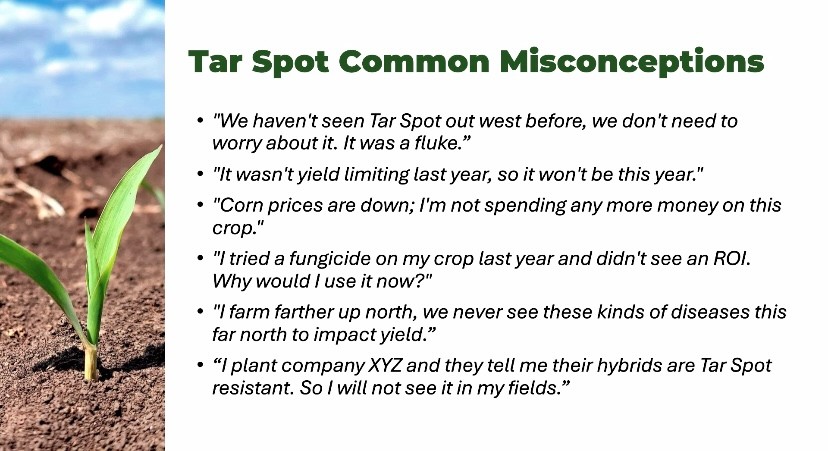
“We want people to understand the truth about tar spot and the importance of fungicide in fighting it.” Carlson said. “Misconceptions like ‘It doesn’t limit yield,’ or ‘Fungicide doesn’t’ show an ROI,’ are just that: misconceptions.” Those facts are the facts, and fungicide showed a huge ROI for federated growers in 2025. That likely won’t change in 2026.
However, fungicide isn’t right for every acre. Slater explains: “In lower-productivity fields like non-irrigated sand, the response typically isn’t high enough to pay for itself. Also, oddly shaped, smaller fields are not the easiest to apply on and can lead to more corn rundown than is acceptable. Some corn will get run over when applying on tasseled corn, it doesn’t bounce back like it does during early herbicide applications.”
Trying to preserve every possible bushel is the goal. “What we’re trying to do is protect the yield that is there,” Slater said. “By not letting the plant die early and protecting it from diseases, we are giving growers the best chance to hold onto their bushels.”
We’re still planning applications for 2026, so if you want to have a chance to replicate your 2025 ROI, reach out to your Federated Agronomist today and line up applications or trials.
“On average, we saw about 20-25 bushel-per-acre response from fungicide this year,” said Mike Slater, ag sales rep at Federated’s Isanti location. “Some were obviously lower, but one was as high as 53 bushels per acre.” When an 8-12 bushel response is your typical break-even point, 20 or more is a serious return.
Slater credits the RIO of fungicides to the persistence of tar spot, which seems to be a constant thorn. Kevin Carlson, Federated’s agronomy sales manager, agrees. “Tar spot is everywhere,” Carlson said. “There is no resistance to it; only tolerance. A fungicide that handles tar spot is more than worth the investment.”
For instance, in 2025, the breakeven point on tassel applications of Miravis® Neo with Federated’s lifted ground rigs was 12 bushel per acre. Returns were significantly better than that in most cases, largely due to the prevalence of tar spot.
“We want people to understand the truth about tar spot and the importance of fungicide in fighting it.” Carlson said. “Misconceptions like ‘It doesn’t limit yield,’ or ‘Fungicide doesn’t’ show an ROI,’ are just that: misconceptions.” Those facts are the facts, and fungicide showed a huge ROI for federated growers in 2025. That likely won’t change in 2026.
However, fungicide isn’t right for every acre. Slater explains: “In lower-productivity fields like non-irrigated sand, the response typically isn’t high enough to pay for itself. Also, oddly shaped, smaller fields are not the easiest to apply on and can lead to more corn rundown than is acceptable. Some corn will get run over when applying on tasseled corn, it doesn’t bounce back like it does during early herbicide applications.”
Trying to preserve every possible bushel is the goal. “What we’re trying to do is protect the yield that is there,” Slater said. “By not letting the plant die early and protecting it from diseases, we are giving growers the best chance to hold onto their bushels.”
We’re still planning applications for 2026, so if you want to have a chance to replicate your 2025 ROI, reach out to your Federated Agronomist today and line up applications or trials.